

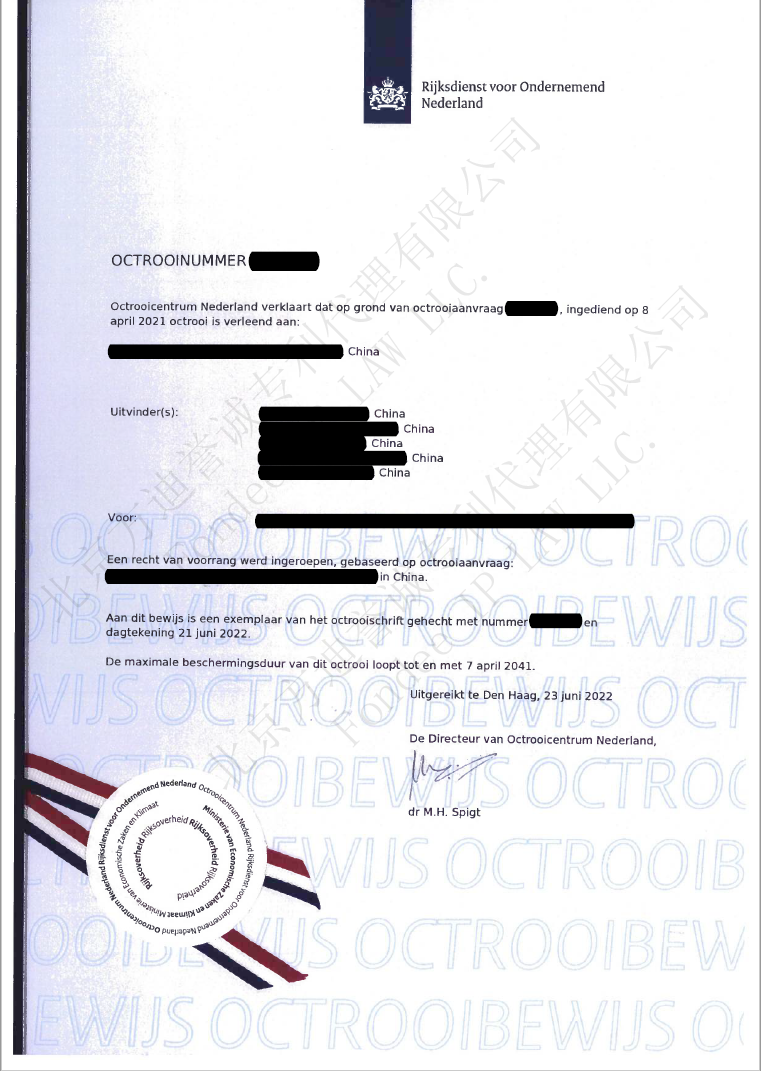
Netherlands
The Netherlands Patent Office (Octrooicentrum Nederland) is the authority responsible for Dutch national patents. The Dutch domestic system offers only invention patents with a 20-year term and does not provide a utility model regime. Its most distinctive feature is that it follows a grant model without full substantive examination. After filing a national patent application, the applicant normally completes a prior-art search and receives a search report and written opinion prepared by the European Patent Office (EPO); however, the outcome of that search does not in itself determine whether the patent will be granted. If the formal requirements are met, the national patent may still proceed to grant, which means that the legal robustness of a Dutch national patent is often tested later in commercial negotiations, licensing practice, or judicial proceedings.
Even without full pre-grant substantive examination, the EPO search report and written opinion still provide meaningful predictability, enabling applicants to assess the likely boundaries and vulnerabilities of the right at an early stage. For this reason, Dutch national patents are frequently used to obtain local protection quickly, secure a priority position, or serve as supporting assets within a broader European filing strategy. For applicants seeking highly stable and cross-border enforceable rights, however, the more common route remains obtaining a European patent via the EPO and validating it in the Netherlands.
In litigation, the Netherlands enjoys a particularly strong reputation in the European patent community. The District Court of The Hague has a specialised IP chamber and occupies a central role in hearing patent infringement and invalidity disputes on a nationwide basis. Dutch courts are widely respected for their technical sophistication, procedural efficiency, and cross-border orientation, and they have historically drawn attention for granting cross-border injunctions in appropriate cases. With the operation of the Unified Patent Court (UPC), The Hague continues to serve as a key node in Europe's patent dispute-resolution architecture.