

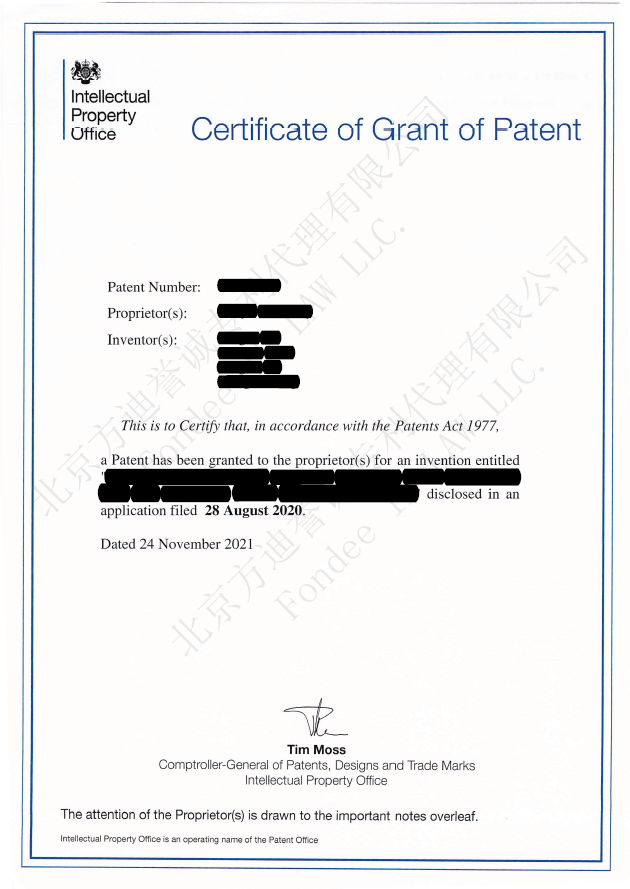
United Kingdom
The United Kingdom Intellectual Property Office (UKIPO) administers and operates the UK patent system. As to protectable subject matter, the UK offers only invention patents with a 20-year term and does not have any form of utility model system. The prosecution process generally involves formal examination, prior-art search, and substantive examination, and applicants are expected to actively move the application forward. In most cases, an applicant must request search within 12 months of the filing date and request substantive examination within 6 months of publication; the precise deadlines depend on the notice issued by the UKIPO in the particular case, and failure to comply may result in termination of the application.
Substantively, the UK Patents Act 1977 remains closely aligned with the European Patent Convention (EPC) on core requirements such as novelty, inventive step, and industrial applicability. That said, UK practice tends to rely more directly on domestic case-law methodology—most notably the "Windsurfing/Pozzoli" line of reasoning—rather than mechanically following the EPO's problem-and-solution approach. A particularly important feature of UK practice is its cautious, and often strict, treatment of computer-implemented inventions (CIIs) and business methods. To address excluded subject matter, the UK applies the "Aerotel/Macrossan" framework, requiring the claimed invention to make a substantive "technical contribution" beyond the mere running of a computer program. As a result, patents directed mainly to software logic or business schemes often face a comparatively high threshold in the UK.
In litigation, the UK differs sharply from Germany's bifurcated model. Questions of infringement and validity are typically handled together within the same proceedings. The High Court's Patents Court hears high-value and technically complex patent disputes, while the Intellectual Property Enterprise Court (IPEC) offers a more streamlined and cost-controlled forum for SMEs. The UK disclosure process, although more restrained than U.S.-style discovery, remains relatively robust by European standards. This gives the UK meaningful strengths in evidentiary access, technical fact-finding, and injunctive relief, while also contributing to comparatively high litigation costs.