

Canada
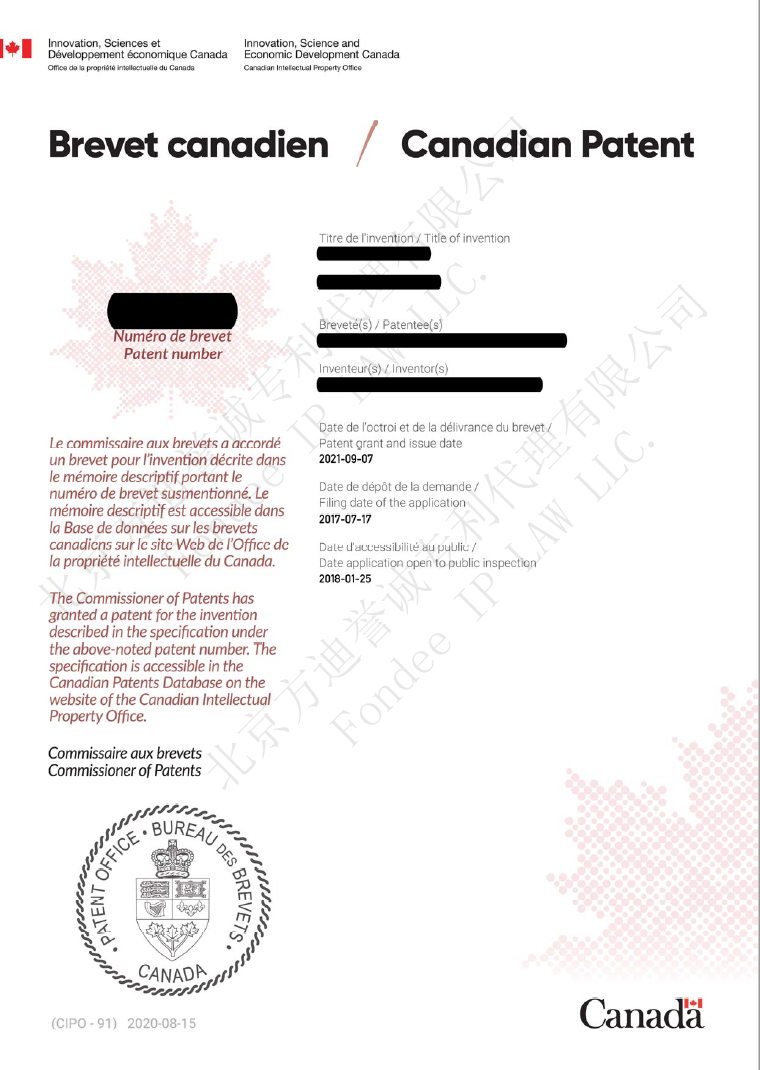
The Canadian Intellectual Property Office (CIPO) administers patent applications and grants in Canada. The Canadian system provides only invention patents with a 20-year term from the filing date; it does not offer utility models or short-term patents. Similar to the United States, Canada also provides a relatively applicant-friendly one-year statutory grace period. If, within one year before the Canadian filing date (or the relevant international filing date for a claim of benefit), the invention was disclosed by the applicant or by a person who obtained knowledge of it directly or indirectly from the applicant, that disclosure will generally not destroy novelty.
Substantive examination in Canada is deferred and must be requested by the applicant. Under the current framework, most applications must be put into examination within four years of filing. Unlike the stringent U.S. IDS regime, Canada does not impose an equivalent obligation on applicants to proactively submit all known prior art, and therefore does not typically generate the same kind of "unenforceability" risk associated with inequitable conduct in U.S. law. That said, applicants must still respond fully to prior-art citations, patentability objections, and procedural requirements raised by the examiner. On patent-eligible subject matter, Canada has in recent years continued to refine its practice in relation to computer-implemented inventions, medical diagnostics, and medical uses, reflecting a combination of common-law judicial development and evolving administrative guidance.
In enforcement and regulatory practice, the structure of Canadian jurisdiction requires careful distinction: patent infringement actions may generally be brought either in the Federal Court or in a provincial court, whereas actions seeking a declaration of patent invalidity must be brought in the Federal Court. In the pharmaceutical sector, Canada operates a patent-linkage regime under the Patented Medicines (Notice of Compliance) Regulations (PMNOC Regulations), functionally comparable in many respects to the U.S. Hatch-Waxman framework. Innovator companies may list relevant patents on Health Canada's Patent Register, and if a generic company seeks market approval before expiry of those patents, the innovator may commence proceedings under the PMNOC regime, triggering a statutory stay of up to 24 months. This mechanism has made Canada a major North American forum for pharmaceutical patent disputes.